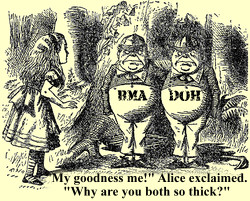
 Of all the reasons to end a long and bitter industrial dispute, imposing an unwelcome contract on a demoralised workforce to “end the uncertainty” has to be the most bizarre, given the inevitable outcome of the imposition will be not less, but more uncertainty. The demoralised workforce, our junior doctors, are already in bad shape, overstretched and in poor morale. Record numbers are considering – though we don’t yet know how many will pull the ejector seat lever – working abroad. Late last year we learnt that almost half of juniors completing their foundation training chose not to proceed directly with their training – a sure sign of ambivalence about the direction of their chosen career. Hospitals face unprecedented recruitment problems, winter pressures are now being mirrored by summer pressures, with the imminent prospect of all year round pressures. The health service is in a critical way, at risk of implosion. So what does the Health Secretary do when he doesn’t get his own way with the juniors? He hits them on the head. Hard.
Category: Mismanagement
The Last Junior Doctor
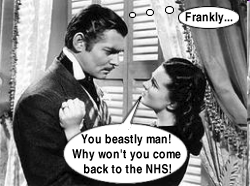 As the post nuclear option Heremy Junt/BMA contract row rumbles on behind the scenes – the top hit on google news today for junior doctor contract is a three day old blog post on Conservative Home by a psychiatrist sorely in need of Photoshop if ever there was one, and the BMA’s ‘latest update’ is weeks old, a thoughtful post by JT reminds us that the opposing comedy duo of Junt and the BMA Junta are not the only threats to junior doctors. The SPECTRE known for the time being as NICE, the National Institute for Clinician Evisceration, has produced yet more guidelines on statins. Commendably dense with the rhetoric of patient choice, the general thrust is nonetheless on upping the uptake. JT’s gripe is three fold. The first is that clinical guidelines, statistical tools, algorithms, call them what you will, become wet paper bags when they attempt to contain the complexity of real life. The second is that guidelines alongside variations of payment by result tends to get, well, results, ie more people on statins, without care for whether they want them or need them. The third, touched on more briefly, but just as important, is that, up against the hour glass of surgery time, thoughtful deliberation never stood a chance. It is the dead duck floating feet defiantly up, but head drowned in the time-hoopered barrel of clinical complexity.
The Strike That Passed in the Night
 At the eleventh hour, the BMA suspended the junior doctors’ strike. It hasn’t been called off entirely, it may still happen, but probably won’t. As a conspiracy theorist, Dr No suspects the whole shebang was a clever ruse by the doctors: a strike that was not a strike, a neat foil to Absolutely Stilton’s tanks lining up in the hospital car park; as a cock-up theorist, he suspects the whole bang shoot is further evidence that, even if it wanted to, the BMA couldn’t fire a rocket on Guy Fawkes Day. Apart from some bizarre even by Daily Mail standards doctors’ leader in love nest in Neasden style hackery, not to mention its doctors on dark web exposé, media coverage has been thin for what is after all serious domestic news. At the coming up of the sun, the Today programme looked the other way, and at the going down of the sun, Hoo Wedwards and his harem of squawking reporterettes hardly ever mentioned the conflict. There was some coverage of the ‘overwhelming’ 98% in favour ballot result, but few pointed out that 98% of those who voted is about just over half of all junior doctors, though even that is still an eye-watering result. For the BBC in particular, the junior doctors’ contract was, like the Health and Social Care Bill before it, to be just another ship that passed in the night.
Not Entirely Appropriate
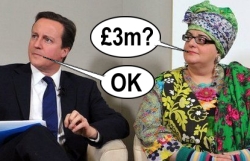 Supposed once by David ‘Hug a Hoodie’ Cameron to be the embodiment of big society in a way that say dear Joanna Lumley never could be, Camila Batmanthingy exploded last week as her charity Kids Company imploded. Boy, was it a big explosion, as if Demis Roussos, once described by Clive James as another larger than life Phenomenon having an immense reserve of inner warmth, had exploded. Appearing with a succession of ever more luminous ever larger tablecloths wound round her head and wrapped round her body, she railed and ranted against the media rumour-mongers who, she said, had caused Kids Company to come crashing down, in the space, she would have us believe, of a few days, if not hours. Other accounts have it that, like Icarus before her, Camila flew too high, and the steady heat of scrutiny melted the wax of her charity. The collapse was as complete as it was sudden.
Ill Winds
 The other day we had David Cameron getting pumped up about a seven day NHS. Pumped up is the New Tory, but a lot of old hats were still put on pegs, some hats more moth-eaten than others. JC (of the Department of Health Sunshine Band) was wheeled onto the Today programme, sounding about as pumped up as a flat tyre. Despite the ill wind blowing today through NHS General Practice, with more vacancies than currants in a bun, the government’s prescription is five thousand more GPs. Quite which wind these GPs will arrive by has yet to be explained. Historically, the NHS has outsourced, or at least gained, extra doctors from abroad. Pigs, after all, can always fly, if they are pumped up enough.
Thanks For Coming In Today
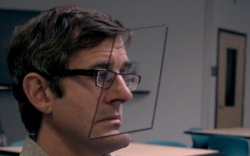 Wearing togs of mailbag grey, but missing the convict’s vertical arrows, Louis Theroux’s cubist aspect stalked the corridors of an American asylum for the criminally insane, searching for nutcases. The nutcases failed to stand out. Scanning a corridor, it was not possible to discern whether that man with a trolley was a janitor on rounds or an axe-murderer who just might rip the steel bars off his trolley and wrap them tightly round your neck. To make matters even more confusing, some of the staffers looked pretty nutty. Only the psychiatrist was easier to spot, dressed in a cream suit from last year’s fashion rail at the local charity shop. She’d come a long way, from Lithuania to be precise, and had three settings: stern, giggly and frightened rabbit, as well she might, given the human powder kegs she sat on. This being a psychiatric instatooshn, ward rounds and meetings were called reviews, many opening and/or closing with that old psychiatric smoothie, ‘Thanks for coming in today’. Despite the smoothness, it tends to sound a bit hollow when addressed to an inmate who has not a hope in hell of not coming in today to the review.
Making Ministers Happy
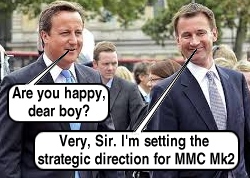 Just as forecasters talk of a ‘fog situation’ or a ‘snow event’, so do medical educators now talk of the ‘shape of training’. Why the accessory words are needed is beyond Dr No, but then again he is not all that surprised because the recent Shape of Training Review – hashtag ShoT or in this parish bashtag ROT – was led by a certain eminence situation, one Prof Sir David Greenaway, a distinguished looking egg-head and leading light from the science that makes astrology look good. The #ShoT review’s publication situation was treated by and large as a no news situation – maybe being #ShoT didn’t help – though for some reason the BBC did cover it, and of course our dear friend the Ferret Fancier has been poking holes in the review for some time. One of the Ferret Fancier’s notable achievements has been, on appeal, to get an order for the release of certain GMC minutes of #ShoT/DoH meetings, which the GMC had previously determined should most definitely remain as an ongoing non-situation.
Discipline Makes Daring Possible
 When the Chief Medical Officer feels uncomfortable, should the nation tremble? Probably not. Certainly, Dr Atul Gawande didn’t, fielding Dame Sally Davies’s troubled comments after giving his second 2014 Reith Lecture, broadcast this morning on Radio Four. Speaking in his now familiar, you know, George W Bush style “Our people done a really good job…of, you know…hauling in a lot of the key operators”, Gawande extolled the virtues of getting systems right. Goaded by air industry experts baffled at the casual approach of surgeons to their work, Gawande developed The CheckList. Depending on viewpoint, the CheckList is either strictly for the dumb-assed, or a sort of systems alchemy that transforms the inept into the ept, and experts into super-experts. Doubters are stumped and declared out for a duck by asking them a simple question: “If you’re having an operation, would you want the team to use the checklist?” Unsurprisingly, ninety four percent did, though that leaves the intriguing question what did the other six percent want? Dr Frankenstein? A one armed blind surgeon with a prosthetic hand and Parkinson’s disease? We’ll probably never know, because by now they will have maimed or killed themselves some other way.
Shakin’ Stevens
 Yesterday’s news was bob-a-job docs, £55 for each and every dementia diagnosis, with old hands who should know better – they have been handbagging item of service fees in various shapes and forms since the beginning of time – decrying the idea as bribery, likely to cloud professional judgement, possibly even unethical. Dr No will believe their wails when they start handing back the contents of their handbags. For his part, Dr No thinks the idea, though crude, is not without merit, even if the sum is paltry for what is rather more long-term work than a snap diagnosis, because it sends a signal in terms the ex-apothecaries have always understood – payment for an item of service. Dementia is under-diagnosed, and patients and carers who want to know and plan miss out on help that is or at least should be available. Indeed, upping the recorded prevalence might even push up dementia funding. So all in all, though a bit grubby, the idea gets Dr No’s approval.
Toothless Wonder
 Dr No gazed in open-mouthed if not toothless wonder as the first episode of Frankie (BBC1) unfolded last night. Not content to be the life and soul of the party, Frankie, a SuperNurse for the time being on the district beat, is the life and soul of the known universe. In a script that pasted it on like a bricklayer mortaring a wall, Frankie was given lines to assist even the dimmest viewer to a full comprehension of Frankie’s awesome powers. When cutbacks have ordinary doctors and nurses quivering, what does Frankie do? Why, she laughs at the cuts! When a cut of a literal sort threatens to come her way in the hands of a demented war veteran, she turns the other cheek. Nothing is beyond the toothless wonder’s extraordinary powers. When a child arrests in her car, Frankie becomes paramedic and then emergency ambulance driver; later, she turns her hand to a spot of midwifery. Dr No suspects Frankie has a fold-up operating theatre in the boot of her car, and in later episodes will turn her hand to a spot of surgery. Nothing is beyond Frankie for, as she told at least one gagging viewer, ‘the world is her patient’. When not fixing the world, Frankie likes to turn up the stereo, and dance, turning the show into a musical: Frankie Goes To Bollywood. Truly, nothing is beyond Frankie, but then, Dr No supposes, that is what happens when you have done Torchwood. Even Captain Jack has been turned into a shadow of his former self, a hapless plod who’s always got the wood, but never gets his way, because every time he gets his pecker out, Frankie’s away.